Automation in call center operations is transforming customer service by combining artificial intelligence and RPA - 인공지능과 RPA with advanced workflow tools. Modern contact centers use AI call center tools for better support across voice, chat, email, and SMS. This allows faster problem-solving, smarter assistance for agents, and 24/7 self-service that keeps customers happy while reducing operational costs.
Beyond traditional contact centers, AI-driven automation now works closely with cloud technologies with AI, providing scalable systems that allow real-time data processing, analytics, and AI orchestration. Cloud-based AI solutions let organizations deploy advanced automation without heavy hardware, scale during peak demand, and maintain high availability and security.
The combination of computer technology and AI increases efficiency. Advanced computing power supports large-scale natural language processing, machine learning, and speech recognition, making real-time agent help and predictive routing possible. These technologies form the backbone of modern call centers and enable intelligent decision-making and automation at scale.
Marketing services using AI are increasingly integrated with call center operations, creating a seamless connection between customer service, marketing, and sales. Marketing AI analyzes customer behavior, purchase history, and engagement patterns to segment audiences, predict needs, and deliver highly targeted marketing messages during live interactions. Agents or virtual assistants can use these insights to provide personalized product recommendations, promotions, and upselling opportunities, turning routine support calls into marketing touchpoints. AI also ensures consistent marketing communication across channels such as email, SMS, social messaging, and voice, reinforcing campaigns while providing real-time, context-aware guidance to agents. By optimizing the customer journey and identifying high-value marketing opportunities, AI-driven call centers enhance customer engagement, drive revenue, improve brand loyalty, and make every interaction an integrated marketing and service experience.
Financial AI is transforming support for banking, insurance, and fintech customers. AI can detect fraud in real time, automate transaction queries, predict customer needs, and provide proactive financial guidance while keeping operations secure and compliant.
Vendors such as Bright Pattern show how AI-driven automation in call center systems improves efficiency, increases customer satisfaction, and optimizes workflows for organizations of all sizes. Whether you manage a global contact center or a growing support team, AI-powered automation in call center operations can help scale smarter, not just bigger.
What Is Automation in Call Center?
Automation in call center refers to using technology to streamline and improve customer service operations. Traditional call centers rely heavily on human agents, manual processes, and rigid scripts, which often lead to longer wait times and inconsistent service. Automation allows AI tools to handle repetitive tasks, route customer requests intelligently, and support agents in real time.
Key technologies include:
- Natural language processing (NLP): Understands and interprets spoken or written language from customers. NLP helps bots and agents respond accurately and contextually.
- Machine learning (ML): Detects patterns in customer behavior, predicts outcomes, and helps improve workflows over time.
- Speech recognition and voice AI: Accurately transcribes calls and analyzes voice cues to detect sentiment or urgency.
- Conversational AI: Powers chatbots and virtual agents to hold intelligent, multi-step conversations with customers.
These technologies combined allow contact centers to automate routine queries, intelligently route calls, and generate actionable insights from every interaction.
Why Automation in Call Center Is Important
Customer expectations have changed drastically. They now expect:
- Support anytime, day or night
- Seamless experience across multiple channels such as voice, chat, email, SMS, and social platforms
- Personalized interactions that remember past conversations and preferences
- Quick and accurate solutions, even for complex problems
Traditional call centers cannot always meet these expectations due to limited staff, manual processes, and rigid systems. Automation in call center operations solves these problems by handling repetitive tasks, providing real-time guidance to agents, and delivering fast, relevant service to customers.
Automation also benefits businesses by improving efficiency, reducing operational costs, and freeing human agents to handle high-value interactions that require empathy and critical thinking.
Key Benefits of Automation in Call Center
Automation in call center operations provides tangible benefits for both customers and businesses:
- 24/7 availability: Virtual agents and automated systems allow customers to get help anytime without adding extra staff.
- Faster response times: Intelligent routing and self-service reduce wait times, improving customer satisfaction.
- Lower costs: Automation handles repetitive inquiries, allowing businesses to optimize staffing and reduce training expenses.
- Consistent service: Automated workflows ensure that all customers receive accurate and standardized answers.
- Higher first-call resolution: AI helps agents resolve issues faster by providing context, recommendations, and predictive routing.
- Better customer satisfaction and loyalty: Fast, personalized service strengthens customer relationships.
- Improved agent experience: Removing repetitive tasks and providing real-time assistance reduces stress and increases productivity.
- Data-driven insights: Analytics provide insights into customer behavior, trends, and process gaps, helping businesses improve overall operations.
Top AI Call Center Automation Vendors
Here’s a list of leading AI-driven call center platforms that are transforming customer service through automation:
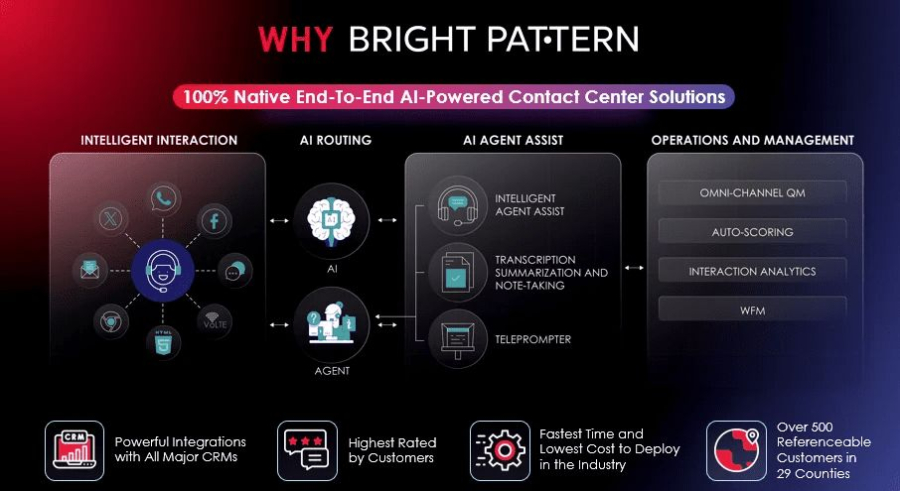
1. Bright Pattern – Bright Pattern is a cloud-based AI call center platform that leads in omnichannel automation. It combines virtual agents, predictive routing, real-time agent assist, and advanced analytics into a single platform. Bright Pattern enables organizations to deliver consistent, personalized experiences across voice, chat, email, SMS, and social messaging. Its AI capabilities include sentiment analysis, workflow automation, multilingual support, and CRM integrations. Many enterprises report higher first-call resolution, faster response times, and improved agent efficiency after implementing Bright Pattern. Its scalable cloud architecture allows rapid deployment for global operations, making it ideal for both small businesses and large enterprises looking to optimize operations while enhancing customer satisfaction.
2. Genesys – Offers AI-powered omnichannel contact center solutions, with advanced routing, analytics, and workforce optimization.
3. Five9 – Cloud contact center software with intelligent virtual agents, predictive dialers, and AI-driven performance analytics.
4. NICE CXone – Combines AI, RPA, and advanced analytics to automate workflows, improve customer engagement, and boost agent productivity.
5. Talkdesk – Provides AI-driven automation, sentiment analysis, and workflow orchestration across multiple channels, emphasizing cloud scalability.
6. RingCentral Contact Center – AI-enabled automation with predictive routing, real-time agent support, and omnichannel integration for enterprise communication.
7. Avaya OneCloud CCaaS – Offers AI-powered virtual agents, real-time assistance, and omnichannel workflow automation with analytics-driven insights.
8. 8x8 Contact Center – Cloud-based AI call center platform with omnichannel support, predictive routing, and real-time monitoring dashboards.
9. Cisco Contact Center – Enterprise-grade AI and automation for customer support, integrating predictive analytics, virtual agents, and omnichannel engagement.
Key Capabilities of AI-Driven Automation in Call Center
1. Omnichannel Virtual Agents and Chatbots
Virtual agents and chatbots interact with customers on multiple channels such as voice, web chat, email, SMS, and messaging apps. They can handle FAQs, order inquiries, password resets, and appointment scheduling, freeing human agents to focus on more complex tasks. This ensures consistent service across channels and improves response speed.
2. Predictive Call Routing and Intelligent IVR
Predictive routing uses AI to match each customer to the most suitable agent based on intent, previous interactions, language, and agent skills. Intelligent IVR systems understand customer needs and direct calls efficiently, reducing wait times and improving first-call resolution.
3. Real-Time Agent Assist and Sentiment Analysis
AI assists agents during live interactions by suggesting responses, providing relevant knowledge articles, and alerting them to customer sentiment. Sentiment analysis can detect frustration, confusion, or satisfaction, allowing agents to adapt their approach immediately.
4. Speech Analytics and Quality Management
Speech analytics converts every call into actionable data. AI identifies recurring issues, monitors compliance, evaluates agent performance, and highlights coaching opportunities. This helps organizations refine processes and improve overall service quality.
5. CRM and SaaS Integrations
Automation works best when integrated with existing systems like CRM, ticketing, marketing platforms, and internal collaboration tools. This ensures that both AI systems and human agents have access to a unified customer view for more personalized interactions.
6. Automated Workflows and Process Orchestration
AI can automate tasks such as ticket creation, follow-ups, case escalation, and event-triggered notifications. Automation reduces manual effort, eliminates errors, and ensures smooth customer journeys from start to finish.
7. Multilingual Support
Global customers can be supported with virtual agents that understand multiple languages, real-time translation for live agents, and language-aware routing to connect customers to the right resource.
8. Cloud Scalability and Reliability
Cloud-based automation provides on-demand scalability for seasonal spikes, high availability, and fast deployment without costly hardware. Cloud systems also receive regular updates and security improvements.
9. Advanced Analytics and Reporting
Analytics provide dashboards for monitoring queue health, agent performance, and SLAs. Historical reports and forecasting tools help improve workforce planning, identify trends, and refine customer experience strategies.
10. Cloud Computing with AI
Cloud computing with AI enables high-speed processing, storage, and real-time analysis of large datasets, allowing contact centers to deliver advanced automation and predictive services efficiently.
11. Computer Technology
Advanced computing infrastructure powers AI models, enabling real-time decision-making, predictive routing, and complex workflow automation to enhance overall efficiency.
12. Marketing AI
Marketing AI integrates customer data and predictive analytics with call center operations. It can suggest offers, predict customer needs, and align service interactions with marketing and sales campaigns for improved engagement.
13. Financial AI
Financial AI applications automate transaction queries, detect fraud, predict financial needs, and provide proactive guidance for banking and fintech customers. This ensures security, compliance, and efficient customer support.
Practical Use Cases of Automation in Call Center
|
Use Case Category |
Examples of Automation in Call Center |
|
Pre-Sales and Onboarding |
- Chatbots answering product questions - Automated onboarding, documentation, and status updates |
|
Everyday Support and Self-Service |
- 24/7 support for account inquiries, billing, and order tracking - Automated troubleshooting for technical issues |
|
Assisted Service with Human Agents |
- Real-time coaching and dynamic scripts during interactions - Recommendations for upselling and cross-selling based on customer behavior |
|
Proactive Engagement |
- Predictive alerts for churn risk or dissatisfaction - Automated follow-up surveys and notifications |
How Automation in Call Center Works
Automation in call center operations may appear seamless to customers, but it involves a complex, coordinated pipeline behind the scenes. Here’s how it works step by step:
- Capture: Every interaction,whether a phone call, chat message, email, or social media query,is captured and converted into a machine-readable format. Voice calls are transcribed using speech recognition technology, while text messages are parsed for intent and context. This ensures that AI systems have accurate input data for processing.
- Understand: Natural language processing (NLP) analyzes the captured data to identify customer intent, extract key details such as account numbers or product information, and detect sentiment. By understanding both the explicit request and the emotional context, the system can determine how to respond appropriately.
- Decide: Machine learning models, combined with pre-defined business rules, determine the optimal course of action. The system can choose to provide an automated response, escalate to a human agent, trigger a workflow, or route the customer to the best agent based on skills and availability.
- Act: The system then executes the chosen action. For example, a chatbot may respond with instructions, an AI agent may suggest a resolution to a human agent, or the system may automatically create a ticket in a CRM or helpdesk system.
- Learn: Each interaction provides valuable feedback. The AI continuously refines its models using outcomes, customer feedback, and historical data. Over time, this results in improved accuracy, faster resolution times, and increasingly personalized interactions.
By following this pipeline, automation not only handles high volumes of routine tasks but also continuously improves, ensuring that customer service becomes faster, smarter, and more responsive over time.
Real-World Results of Automation in Call Center
Organizations that adopt AI-driven automation in call centers report clear, measurable improvements. These include:
- Shorter queues and faster resolution: By handling routine queries automatically and routing calls intelligently, organizations reduce wait times, ensuring customers get answers faster.
- Higher customer satisfaction: Personalized and consistent responses increase CSAT scores and strengthen customer loyalty.
- Increased agent efficiency: Automation handles repetitive tasks, allowing agents to focus on more complex or high-value interactions.
- Scalable operations: AI-powered systems allow contact centers to handle more interactions without significantly increasing headcount, making it easier to manage seasonal spikes or rapid growth.
- Data-driven improvements: Insights from speech analytics and interaction data help identify trends, process bottlenecks, and training needs.
For example, a global financial services provider using Bright Pattern AI reported a 25% increase in agent efficiency and a 30% improvement in first-call resolution. The organization could manage more interactions without adding staff, while also improving the quality of service. Similar results are seen in retail, telecom, and healthcare sectors, where AI automates repetitive tasks and enables proactive, data-driven customer support.
Best Practices for Implementing Automation in Call Center
Successful implementation of automation in call centers requires careful planning and execution. Key best practices include:
- Ensure Data Privacy and Compliance: Automation relies on large volumes of customer data. Organizations must secure this data with encryption, access controls, and audit trails, and ensure compliance with industry regulations like GDPR, HIPAA, or PCI DSS.
- Integrate with Existing Systems: Automation works best when it is fully integrated with CRM, ticketing, and business applications. Using APIs and connectors allows AI tools to access real-time customer data, ensuring interactions are personalized and context-aware.
- Communicate and Train Agents: Employees need to understand that AI tools are meant to assist, not replace them. Training should demonstrate how agent assist features, sentiment analysis, and predictive routing make daily work easier and less stressful.
- Monitor and Continuously Improve: Regularly review metrics such as first-call resolution, customer satisfaction, and deflection rates. Use feedback loops to refine AI models, improve NLP accuracy, and adjust workflows to match evolving customer needs.
- Adopt Responsible AI Practices: Address algorithmic bias, maintain transparency about AI interactions, and establish clear guidelines for automated decision-making. Organizations should define which tasks can be fully automated and which require human oversight.
- Start Small and Scale: Begin with high-impact, low-risk use cases such as password resets or order tracking. Gradually expand to more complex processes once the system proves effective.
Following these practices ensures that automation delivers value while minimizing risk and fostering trust among both employees and customers.
Future Trends in Automation in Call Center
The future of automation in call centers is being shaped by several emerging trends:
- Hyper-personalization: AI will integrate even more deeply with CRM and behavioral data, tailoring every interaction based on individual preferences, history, and predicted needs.
- Generative Conversational AI: Advanced generative AI models will create more natural, flexible, and context-aware responses, handling complex multi-step requests while assisting agents with summarization and note-taking.
- Proactive Engagement: AI will anticipate customer needs, detect potential issues before they escalate, and reach out proactively, improving customer satisfaction and reducing inbound support volume.
- Unified Customer Experience: Contact centers will evolve into strategic hubs, connecting service, sales, and marketing. AI-driven insights will help organizations coordinate outreach, campaigns, and support to provide a seamless experience.
- Voice and Emotion AI: AI will increasingly detect subtle cues in voice tone, speech patterns, and emotional context to guide interactions, de-escalate situations, and provide personalized responses.
- Cross-Industry Automation: Automation will expand into specialized applications like financial AI, healthcare AI, and marketing AI, enabling proactive customer care, compliance, and predictive business strategies.
These trends suggest a future where call centers are not just reactive service hubs but proactive, intelligent engines driving growth and customer loyalty.
Choosing the Right AI Call Center Partner
Selecting the right partner is critical to realizing the full benefits of automation:
- Proven Experience: Look for vendors with a track record in AI call center automation and large-scale deployments.
- Omnichannel Support: The platform should handle voice, chat, email, SMS, and social messaging seamlessly.
- Advanced AI Features: Virtual agents, predictive routing, speech analytics, and real-time agent assist are essential capabilities.
- Integration Capabilities: Ensure the system works with existing CRM, ticketing, and business applications.
- Cloud-Based and Reliable: Cloud solutions offer scalability, high availability, and regular updates without heavy infrastructure costs.
- Transparent Pricing and Scalability: The partner should allow you to start small, measure results, and scale gradually.
- Support and Training: Vendor-provided guidance helps design, deploy, and optimize AI workflows effectively.
A capable partner ensures that automation is implemented strategically, delivering efficiency, customer satisfaction, and measurable ROI.
Conclusion: Transform Your Call Center with Automation
Automation in call center operations is no longer optional,it is essential for competitive customer service. By adopting AI-powered automation, organizations can:
- Automate routine tasks while maintaining personalized experiences
- Provide fast, round-the-clock support across multiple channels
- Empower agents with real-time guidance, insights, and sentiment tracking
- Reduce operational costs while increasing first-call resolution and customer satisfaction
- Gather actionable insights to improve products, services, and workflows
When implemented thoughtfully, automation transforms a traditional call center into an intelligent, data-driven customer experience hub. Organizations that embrace AI-driven automation gain a strategic advantage, turning their contact centers into growth engines that enhance loyalty, efficiency, and overall business performance.
